
 Gaming Tables
 Bar
 Bestsellers
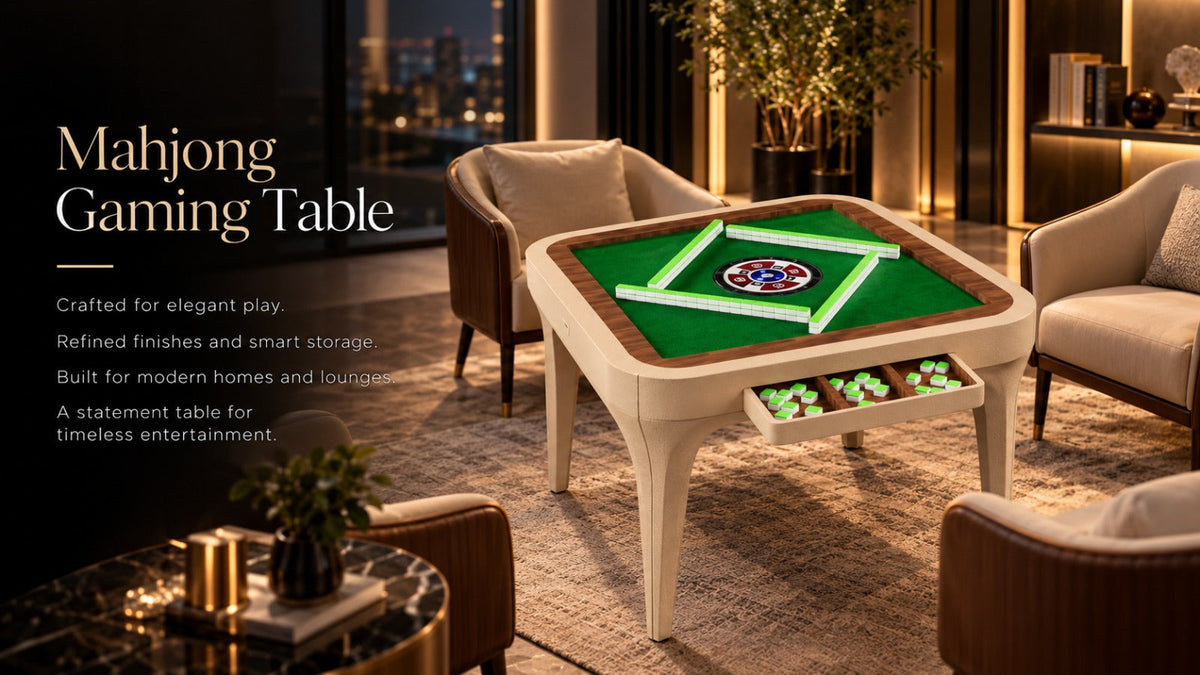
There is one simple reason a luxury game room needs a mahjong set. It brings people to a table and keeps them there. People gather around pool tables. The drinks come from a home bar. Mahjong does something quieter. It slows down the evening, sharpens everyone’s focus, and looks beautiful doing it. This guide is going to outline what Mahjong is, what a quality set consists of, how the game is played, and how to select a set that fits a refined space.
Why a Mahjong Game Set Belongs in a Luxury Game Room
Most game room furniture needs room on the floor. You need clearance on all sides for a pool table. You need space to swing a foosball table. Mahjong requires a square table, four chairs, and a few hours. That's it. In return, you have a game that has had people’s attention since the late 1800s in Qing dynasty China.
It also solves a common problem in game rooms. You get a space, you pay big bucks, and then it's used twice a year. Lots of families play Mahjong weekly. And the clicking of tiles on a Sunday afternoon is a ritual.
Classic Mahjong as a Statement of Taste

Here’s the bottom line: A good set looks like décor even when no one is playing.
The tiles are little works of art. Carved characters, bamboo stalks, red and green dragons, and painted flowers. A set in a lacquered wooden case or a leather-wrapped box sits comfortably on a console or a bar cabinet shelf. Guests see that. That usually results in a game.
What Is a Mahjong Game?
Mahjong is a tile game for four players of skill, memory, and a bit of luck. Your goal is to create a winning hand before anyone else. Think rummy, with tiles and the strategy.
A normal Chinese set contains 144 tiles:
- There are three suits: dots (circles), bamboo, and characters. Each suit has 1 to 9 tiles, and there are four copies of every tile.
- Honor tiles: four winds (East, South, West, North), three dragons (red, green, white)
- Bonus tiles: flowers and seasons (used for extra points in many versions)
When people speak of classic mahjong, they generally mean this version of the four-player Chinese or Hong Kong game. In the 1920s the game arrived in the United States, where it evolved into a number of regional variants, including American, Japanese Riichi, and Taiwanese.
Mahjong vs Mahjong Solitaire: What's the Difference?
They split the tiles. Hardly any other thing.
Traditional mahjong is a multiplayer game based on drawing, discarding, and outthinking the people next to you. Mahjong Solitaire is a single-player matching puzzle game that gained popularity on home computers in the 1980s. You clear a stacked layout by matching free tiles. No competition. Build With No Hands. No looking up in the table.
What Comes in a Mahjong Game Set
A complete set gives you the tiles, the dice, and the tools to track the round and the score. Premium sets add better materials and better storage. That is the difference you feel in the hand.
Expect the following in most sets:
- Tiles: 144 for Chinese and Hong Kong styles, 152 for American sets, which add jokers
- Dice: two or three, used to decide the dealer and where the wall breaks
- Wind indicator: a small marker or disc showing the prevailing wind of the round
- Scoring counters: chips or sticks to settle points without pen and paper
- Racks and pushers: standard in American play, optional in others
- A case: anything from a simple box to a hand-finished wooden chest
Premium materials are where the experience changes. Heavier acrylic or melamine tiles feel solid and sound right when they hit the table. Deep engraving with hand-painted color won't fade after a few hundred games. A fitted case keeps every tile in its slot. Lose one and the evening is over.
Blank Mahjong Tiles and Spares
Good sets include a few spare blanks. Bottom line: they are insurance. If a tile chips or goes missing under the sofa, a blank steps in. Some house rules also use blanks as jokers or as stand-ins for the white dragon. Check the count before you buy. Two to four spares is a sensible minimum.
The Mahjong Card for American Play
If your group plays the American version, you need one extra item: the annual card published by the National Mah Jongg League. It lists every valid winning hand for that year, and it changes each season. Chinese, Hong Kong, and Japanese styles don't use it at all. Decide your version before you buy.
How to Play Mahjong for Beginners
Here is the whole game in a sentence. Draw a tile, discard a tile, and repeat until your 14 tiles form four sets and one pair.
Search "how do you play mahjong game" online, and you'll find a dozen conflicting answers. Most guides on how to play mahjong overcomplicate the first night. Start with the structure instead:
- Pung: three identical tiles, like three 5 bamboo
- Kong: four identical tiles
- Chow: a run of three in the same suit, like 3, 4, or 5 of dots
- Pair: two identical tiles, often called the "eyes"
Each player starts with 13 tiles. On your turn, you draw one and discard one. You are always holding 13, waiting for the 14th that completes your hand. When it arrives, you call "Mahjong" and lay your tiles down. Round over.
Mahjong Rules Every Player Should Know
Four ideas carry a beginner through almost any game.
- Turn order. East is the dealer and goes first. Play then moves around the table counter-clockwise.
- Claiming discards. You can take another player's discard to complete a pung or kong at any time. A chow can only be claimed from the player directly before you.
- Exposed vs. concealed. Claimed sets go face up on the table. Sets you build from your own draws stay hidden, and many versions reward that with extra points.
- Declaring. You can only win with a complete hand. Call it early by mistake, and most tables will penalize you.
A good set deserves the right surface underneath it. If you’re still deciding on one, our mahjong table buying guide walks you through size, felt, storage, and finishes before you commit.
Scoring and Mahjong Game Rules by Region
This is where versions split apart. Hong Kong style counts "faan," or doubles, based on how your hand was built. Japanese Riichi requires at least one scoring pattern and lets you declare when you are one tile away. American hands must match a pattern on that year's card. The basic mahjong rules stay the same everywhere. The scoring sheet doesn't. Agree on house rules before the first tile moves and you'll avoid most arguments.
Mah Jong Set Up: Getting the Table Ready
Shuffle, build the walls, roll the dice, and deal. The first time takes ten minutes. After a few rounds, it takes two.
- Shuffle. Turn every tile face down and mix them with both hands. Players call the sound it makes "the twittering of sparrows."
- Build the walls. Each player builds a wall 18 tiles long and two tiles high in front of them. Push the four walls together into a square.
- Roll the dice. The dealer rolls to choose which wall breaks and where.
- Deal. Each player takes 13 tiles. The dealer takes 14 and opens play with a discard.
- Replace bonus tiles. Flowers and seasons get set aside and replaced from the end of the wall.
A clean mah jong set up also depends on the table itself. A square top around 85 to 90 cm per side works well. A felt or baize surface keeps the noise soft and stops tiles from sliding. Good overhead light helps too.
2 Player Mahjong and Other Ways to Play Mahjong
You don't need four people. The bottom line: two or three players can enjoy a full game with a few tweaks.
2 player mahjong usually keeps the same goal of four sets and a pair. Many groups simplify it by building only two walls, removing chows, or taking out one suit to speed things up. Three-player games are common in Hong Kong and Japan, where the Japanese version is called sanma and drops several tiles from the set. Rules for these formats vary a lot, so settle them before you start.
Apps help too. They are a decent way to learn how to play mahjong before guests arrive, so your first real game at home feels less like a lesson and more like an evening.

Choosing a Mahjong Game Set for a Luxury Game Room
Buy for tile feel, craftsmanship, and storage first. Style comes second, because a beautiful set that plays badly ends up in a cupboard.
Tile quality. Pick tiles up. They should feel weighty and smooth, with no sharp edges. Thin, light tiles feel cheap within minutes.
Craftsmanship. Look for deep engraving rather than printed surfaces. Printed tiles wear. Engraved and hand-painted tiles last decades.
The right variant. Match the set to the game you'll actually play. American play needs jokers and racks. Chinese and Hong Kong styles don't. If your group is new, numerals printed in the corner help a lot. Most how to play mahjong for beginners resources assume you can read tile values quickly.
Storage. A fitted case protects tiles and makes the set display-worthy. Wood, lacquer, and leather all work in a premium interior.
Table compatibility. A dedicated game table makes the biggest difference. At ARGMAC, we design game tables and home bars around exactly this idea: furniture that hosts a weekend tournament and still looks like a centerpiece on a Tuesday. A good surface, the right height, and comfortable seating turn a corner into a room where people genuinely want to play mahjong.
Design and finish. Match the set to the room. Ivory and jade suit warm wood. Black and gold suits darker, moodier spaces.
Conclusion: Make the Mahjong Game Part of Your Entertainment Space
Strategy, tradition, and conversation. Few games have all three in one box. A good set makes your game room worth coming to weekly, not just special occasions. It is a skillful game; it works for beginners, and it looks good on the table and on the shelf.
Pair with a table made for long evenings, good light & comfy chairs. Then deal the first hand. The rest takes care of itself.
