
 Gaming Tables
 Bar
Bar Bestsellers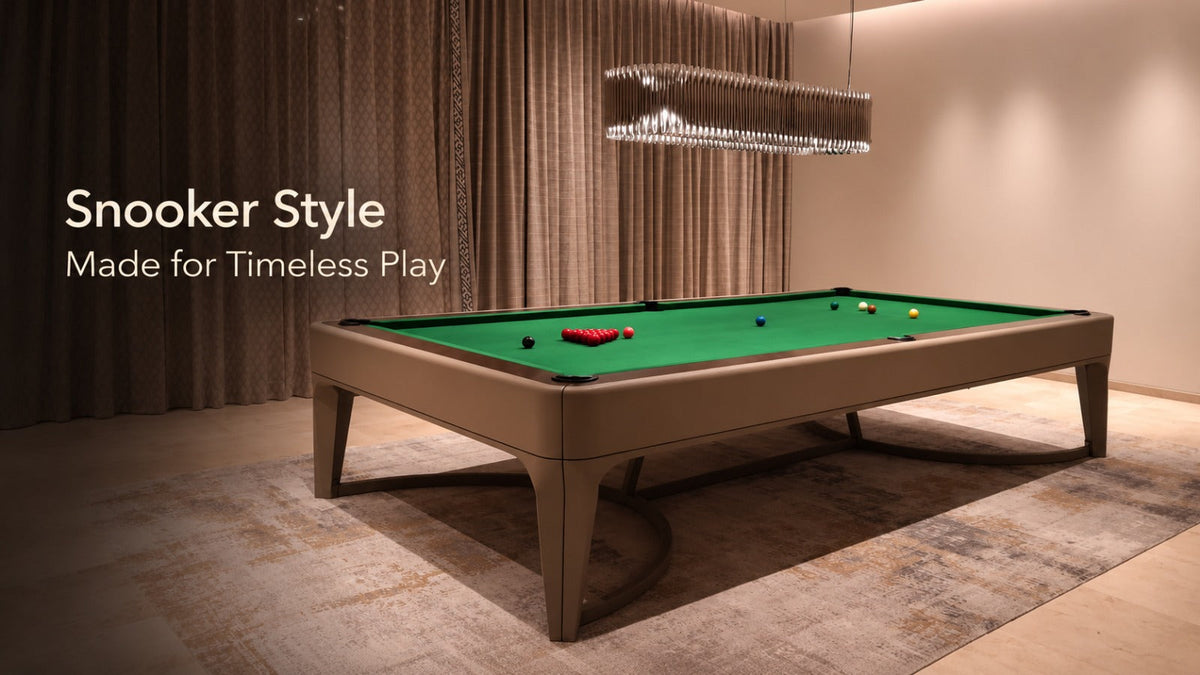
An 8-foot table typically requires about 13.5 by 17 feet. A full snooker table is closer to 16 by 22 feet. Go much smaller and you'll be choking up on your cue every few shots. Your billiards room is determined by one more measurement than the paint, the lighting, or the bar stools. In this guide we cover the clearance maths, where the table should sit, what your floor has to carry, and how finish changes the way a space feels.
Billiards Room Size: The Short Answer!
The rule most installers work with is simple. Take the playing surface of the table, then add the length of a cue plus a little backswing on every side. With a standard 58-inch cue, that works out to about 4 feet 10 inches all the way around. Run the numbers for each common table size, and you get this: a table, not the bed you actually play on. The playing surface of an 8-foot table is approximately 88 inches by 44 inches. Put rails and cushions, and the outer footprint is something like 8.5 x 5 feet. The tournament standard is a 9-foot table. The World Pool Association publishes the precise tolerances for the playing surface and height in its specifications for equipment. Worth a read if anyone in the house plays for real.
Height matters too. The bed usually sits somewhere between 29 and 31 inches off the floor, and your light needs to hang about 32 to 36 inches above that. In a basement with a low ceiling, that gap can get tight fast. So when someone asks how large is a pool table, the honest answer is always "bigger than the number on the label suggests."
Snooker Tables and the Bigger Pool Table Room
Snooker changes everything. A full-size table has a playing area of almost 12 by 6 feet, and the clearance rule pushes the room to around 16 by 22 feet. That is bigger than many living rooms. Plenty of homeowners settle on a 10-foot snooker table instead, which still plays well and frees up a few feet in each direction.
Design can make a large table feel lighter. An inclined or open lower structure leaves more floor visible underneath, so the table reads less bulky. But the clearance math does not care about looks. If your space only just fits a snooker table, a 9-foot pool table will often play better than a cramped snooker setup where half the shots are compromised.

Where Should an Indoor Pool Table Go?
Most use a basement, a spare bedroom, a converted garage, or one end of a large living area. There is a catch to each. Basements usually have low ceilings and damp air. Humidity is bad for cloth and wooden frames. Garages heat up and cool down throughout the year. Rooms with large windows have their own problem. The direct afternoon sun fades cloth faster than you might expect. Select a site with a constant temperature, controlled light, and sufficient ceiling height for a proper lamp. Then you measure it twice.
Making a Pool Table in Living Room Spaces Work!
Most open-plan homes have space problems. Imagine the scene. Someone lines up a long shot from the end rail and pulls back the cue, and a guest walking to the kitchen gets a cue tip in the ribs. This is what happens when the clearance zone is a sidewalk. You don't need a dedicated billiards room to avoid such incidents, but you do need to keep the cue zone free of fixed furniture and out of the main path through the house. Being able to move lightweight chairs before a game is a real help.
With living room layouts, the pool table must look attractive when no one is playing, which is most of the time. Therein lies the importance of the finish. The Outlier pool table, for example, sits on a tilted Z-shaped base that turns the whole piece into the room's focal point. Its solid wood frame can be finished in matt, satin, or gloss veneer, so the same table can look warm and understated in one home and sharp and contemporary in another. White pool tables can sit quietly in light, minimal interiors without taking over the room.
Pool Table Slate and Your Floor
Good tables have a slate bed, generally made of three pieces, about one inch thick. Slate keeps the surface flat and fast for years. It is heavy also. A full slate table will generally weigh between 300 and 450 kg, and all that weight is borne on four legs or a single base. That’s not usually a problem on a concrete ground floor. If it’s an upper floor with timber joists, get a structural engineer to have a look before the table arrives.
Now add to the weight the bodies of stone and marble. Marble-bodied tables are meant to stay put, so plan the delivery route as carefully as the room itself. Measure door widths, lift sizes, and any tight turns in the stairwell. The slate is in sections, but the frame doesn't always come apart. Once the table is in place, an installer will level it on-site. A slate bed only plays true on a level base, so don't skip this step.
Picking High End Pool Tables That Suit the Space
Design does have a huge effect on how big a room looks. Even if the floor plan says it fits, the eye is stuffed with the sight of a heavy, carved table with thick legs. A modern, slimmer base does just that. Tables on angled or Z-shaped bases reveal more of the floor below, and that alone makes a tight space feel less cramped. Also a long linear pendant. It keeps the room’s edges dark, so the eye is kept on the table and not the walls.
The Case for a Black Pool Table
Dark finishes never date. Together with deep wall colors, a black frame and black cloth, the table reads as a single solid object, not a piece of equipment. The Negrosno snooker table shows how well this works at full size. Its sloped underside gives the 12 ft frame a lighter, sculpted profile, and with a dark PU finish and matching cloth, the whole table settles into the room like one heavy, deliberate piece.
There’s a trade-off. Dark finishes show chalk dust and fingerprints more readily than lighter woods, so plan on wiping the rails down more often. If you’re working with a smaller billiards room, it’s still one of the best ways to make the table feel intentional, not squeezed in. And if you choose a black pool table, be sure to have lighting that is bright enough over the bed, as dark cloth absorbs more light than green or blue.

Custom Pool Tables for Tricky Rooms
Not all rooms are a neat rectangle. Angled ceilings, columns, bay windows, and odd corners can all leave you a few inches short of standard size. That’s where custom pool tables come in. A slightly shorter table, a narrower rail, and a different base design can turn an almost right room into one that really is.
When Custom Made Pool Tables Make Sense
Custom makes sense in two situations. The first is when a stock size leaves you about 6 inches short on one side and a little change in length of the table takes care of that. The second is when the table needs to match existing joinery, flooring, or a bar cabinet, and an off-the-shelf finish would clash. Remember that custom made pool tables take longer to build than stock models, so make sure you get your measurements finalized before placing your order.
Do Expensive Pool Tables Need More Room?
No. Price does not alter the clearance rule. The size of the table matters. A premium 8-foot table requires the same space as a basic one. What changes is the build. Heavy-duty frames, marble or travertine bodies, and wider rails are features of expensive pool tables, and the weight of these can add a few inches to the footprint and a lot to the load on the floor. Hence, the room size stays the same, but the structural and delivery checks are more important.
FAQs on Planning a Pool Table Room
Is Pool Table Slate Really Necessary?
For anyone who plays regularly, yes. Wood and MDF beds can warp over time, especially in humid weather, and even a small dip throws off how the balls roll. Slate stays flat for decades if the table is levelled properly.
Do High-End Pool Tables Come in Smaller Sizes?
Many do. Most premium designs are available as 7-foot tables, which suit smaller homes and apartments. Check the outer dimensions as well as the playing surface, since wider rails add a little to the overall size.
Can Outdoor Pool Tables Use the Same Space Rules?
The clearance math is identical. The extra planning goes into weather. A table on a terrace needs shade, a fitted cover, and materials rated for heat and moisture. Skip those and the cloth fades within a season.
Are Glass Pool Tables Practical at Home?
They can be. Most designs use glass on the sides or base for a floating look, while the bed underneath is still slate. Expect smudges. They suit owners who don't mind regular wiping.

Conclusion: Measure Before You Buy an Indoor Pool Table
Get the space right first, and everything else becomes easier. Measure the room wall-to-wall, and add about 4 feet, 10 inches of cue clearance around the playing surface, and subtract anything that cannot move. Then check the floor, the delivery route, and the ceiling height for your lamp. Once those boxes are ticked, the fun part begins: choosing a size, a base, and a finish that make the table look like it was always meant to be there. Get the fit right and the table will play well for decades.
