
 Gaming Tables
 Bar
Bar Bestsellers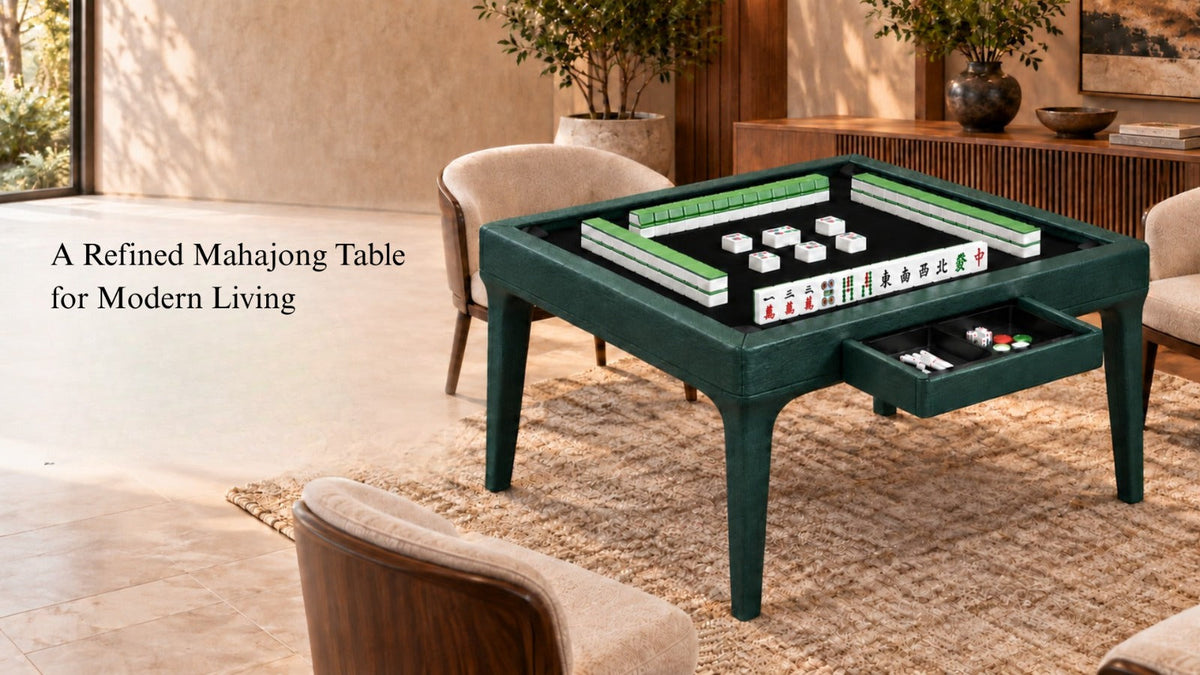
A dedicated mahjong table transforms the game experience at home. Fewer scattered tiles. Better posture. Long rounds that run past midnight without anyone checking the clock.
Most households still play on whatever surface happens to be free. The dining table. A coffee table pushed against the sofa. Occasionally a bedsheet is spread on the floor during festival card nights. It works, right up until a tile slides off the edge and someone's wall collapses mid-hand.
This guide covers what actually matters before you buy: what goes into a set, how much room you need, the folding versus fixed debate, and what separates a proper build from a temporary fix. Mahjong has survived well over a century of family gatherings and house parties. The furniture around it should be built to last just as long.
Why Are Mahjong Board Games Moving Into Luxury Homes?
Because people want a slower, social game that gets everyone off their phones, and the furniture is finally catching up.
Plenty of players first met the game through mahjong puzzles on a phone. It's tile-matching solitaire, played alone on a commute. Others go looking for mahjong cards, expecting a deck like rummy. There isn't one. The game is played with tiles, start to finish, and the mix-up usually comes from its draw-and-discard rhythm, which feels a lot like a card game. Phone puzzles are fun. A deck that doesn't exist is useless. Neither comes close to real mahjong. Four players. A full wall of tiles. That sharp clack when someone declares a win.
That shared, tactile experience is what matters. And it is why designers now plan a dedicated corner for Mahjong board games right next to the home bar or the pool table. The game used to be packed away after Diwali. Now it is staying out, and it needs a surface that looks like it belongs in the room.
What Comes in a Mahjong Set?
A typical Chinese set has 144 tiles, two or three dice, and scoring chips or counters. Other regional variants change the number of tiles, so find out what style your group plays before you buy anything.
Mahjong Tiles Set: How Many Are They, Really?
It depends on the version.
- Chinese (classic): 144 tiles
- American: 152 tiles, adding eight jokers
- Japanese riichi: 136 tiles, dropping the flower and season tiles
The 144-tile breakdown is simple once you see it. There are 108 suit tiles across bamboo, characters, and dots, numbered one to nine with four copies each. Add 28 honor tiles (16 winds and 12 dragons). Then 8 bonus tiles for flowers and seasons.
The mahjong tiles themselves vary in size as well. Larger tiles are easier to read across the table and feel more substantial in the hand. Compact travel sets save space but get fiddly when four people are building walls at speed. For a home game room, go large. Your table should be sized with that in mind.
Why the Mahjong Board Matters as Much as the Tiles

The playing surface affects the sound of the game and the movement of the tiles. That's all there is to it. Tiles skid and clatter on glass and polished wood. Every shuffle is like someone's dropped a tray of cutlery. Felt grips each tile just enough to keep it from drifting but allows it to slide when pushed. Some players buy a loose mat to fix this problem. It helps, but the mats bunch up in the corners and creep toward whoever leans on them the most. A surface built into the table provides a permanent solution to the problem.
Mahjong Table Dimension Guide: How Much Space Do You Need?
A square top about 34 to 36 inches (86 to 91 cm) on a side, a height of about 30 inches (76 cm), and about 3 feet of clear floor on each side for chairs.
Square is a must. Four players build a wall in front of them, and every seat should have equal access to the center. If you go much below 32 inches, the walls begin to crowd the discard area. Go much bigger than 38 and players will be reaching across the table to grab each tile.
The mahjong dimension most people overlook is height. Too low and everyone hunches over within the first hour. Too high and wrists strain while shuffling. Around 30 inches pairs comfortably with a standard dining chair, which is precisely what most guests will be sitting on.
Then there is the room itself. A 36-inch table plus 3 feet of clearance on all four sides comes to roughly 9 feet by 9 feet. That is the realistic minimum footprint. Anything tighter, and chairs will hit walls every time someone gets up for a drink.
A Quick Space Check Before You Order
- Measure the room at floor level, not at skirting height
- Note door swings and walkways that cross the play area
- Plan overhead light directly above the center of the table, not off to one side
- Check the flooring under the legs, since uneven tiles or thick rugs affect levelling
Foldable Mahjong Table or Fixed Build?
Folding works for occasional play and compact flats. If your group plays every week or designs the room around the game, a fixed table wins on stability, surface quality, and looks.
When a Folding Mahjong Table Makes Sense
Festival-season games. A rented apartment. A guest room that doubles as a study the rest of the year. In these cases portability matters more than anything else, and a table that folds flat behind a door is the honest answer.
Lightweight also means one person can set it up without help. For a group that meets three or four times a year, that convenience is hard to argue with.
Where a Foldable Mahjong Table Falls Short!
A folding mahjong table is built to disappear. That is its strength and its limit.
Hinges flex over time. Legs wobble the moment someone leans in to push their wall forward. The felt is usually thin and stretched over the board, which dents easily. And no matter how it is finished, it still looks like something brought out of storage for the evening. In a room with a custom bar or a handcrafted pool table, that contrast is impossible to miss.
What Does the Best Mahjong Setup Actually Need?
Four things: a cushioned surface, a raised edge, storage within arm's reach, and a frame heavy enough that it never shifts during play.
Felt, Rails, and the Sound of Mahjong Tiles
Felt does more than protect the tiles. It controls noise. Shuffling 144 tiles on a hard top is loud enough to wake a sleeping house, and in an apartment, the neighbors too. A dense felt surface softens to a low rumble.
The raised rail matters just as much. When the playing area sits slightly below the frame, tiles stay inside during the shuffle instead of spilling onto the floor. It sounds minor. After the third tile vanishes under the sofa, it stops sounding minor.
Storage That Keeps Your Mahjong Set Together!
Dice go missing first. Then the scoring chips. Within a year, half the accessories are scattered across kitchen drawers, and the case lives somewhere nobody remembers.
Built-in storage resolves the problem quietly. A drawer at the table means everything goes back where it was used, and the next game starts in two minutes rather than twenty.

Inside the ARGMAC Mahjong Table
It is a solid wood, made-to-order piece designed for game rooms that are also part of the living space.
The frame is solid wood in a warm natural finish. Set into it is a recessed felt playing surface, which acts as the mahjong board and cushions every tile so play stays quiet, smooth, and controlled. A concealed pull-out drawer holds dice, counters, and smaller accessories, and built-in storage keeps the full mahjong tile set within reach. Nothing lives in a cupboard across the house.
It also does not look like gaming furniture. It feels like a part of the room. That is the difference between a table you put away and one you leave out, and it is a big part of what makes the best mahjong evenings happen at home rather than at a club.
Made to Order, Down to the Finish
Every table is handcrafted to order. You choose the finishes and detailing, or work with the ARGMAC design team on a fully bespoke specification, where every mahjong table dimension can be matched to your room. Natural veneers carry their own grain and tonal variation, so no two pieces come out identical.
Delivery runs pan-India in protective wooden crating, followed by professional installation and levelling on site. After-sales service and replacement parts are included. ARGMAC pieces have been installed in residences at Oberoi Realty, DLF, and Al Barari in Dubai.
Play Mahjong on Furniture Built for It!
Mahjong rewards the people who take it seriously. The table should too.
Start with the space. Decide between folding and fixed based on how often you actually play, not how often you hope to. Then pick a surface that keeps the tiles quiet and the game moving.
If your game room deserves a centerpiece rather than a stopgap, book a consultation with the ARGMAC Design team or message on WhatsApp to talk through finishes, sizing, and delivery to your city.
