
 Gaming Tables
 Bar
Bar Bestsellers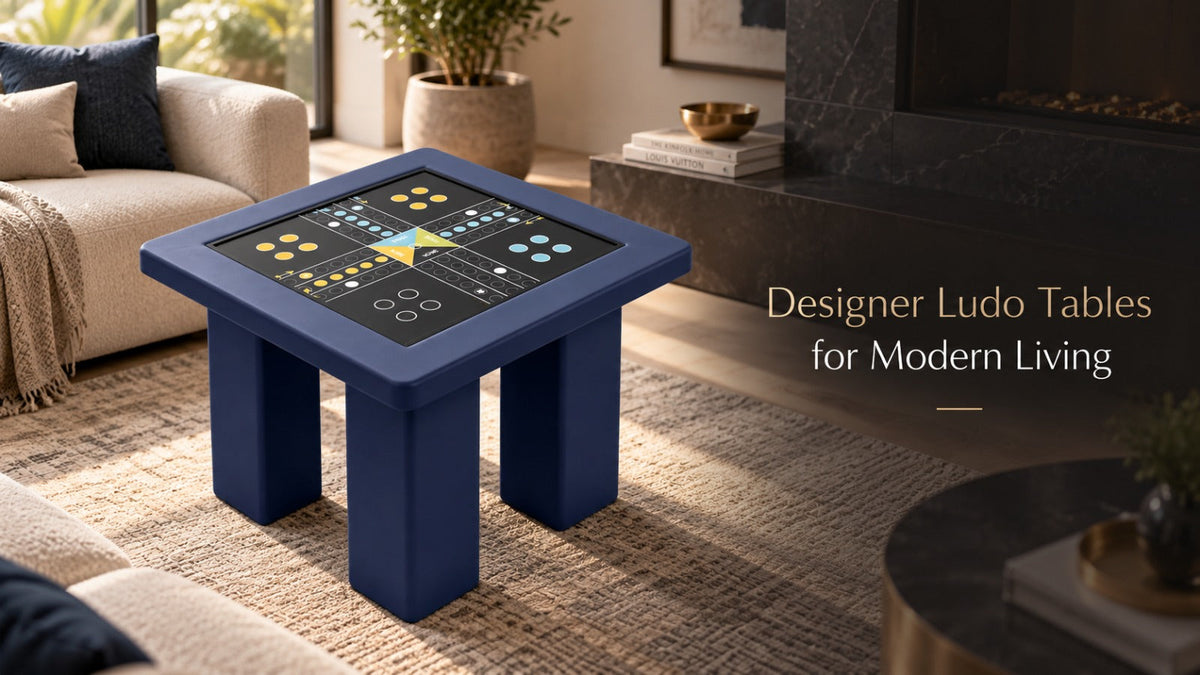
A dice game older than most furniture styles has no business still winning family nights, and yet it does, in almost every house that has ever owned a set. Four colored tracks, four dice rolls, and a home stretch nobody reaches without a little luck. That mix is precisely why the game never really leaves.
The Timeless Appeal of a Ludo Board in Every Home
Most sets end up in a drawer, though, folded into a cardboard box that softens at the corners within a year. That is a storage problem, not a game problem. The rules have not aged. The packaging has, and it shows the moment someone tries to unfold a board that has spent a decade being sat on.
Put the same four tracks on a surface built to stay out, in materials that match the rest of the room, and the whole equation changes. A game that used to come out twice a year for a birthday starts coming out on ordinary evenings, because nobody has to dig for it first.
None of this requires a bigger room or a special occasion. It just requires the board to already be out and within reach, so the decision to play stops being a chore.
This is really a furniture decision dressed up as a game purchase. Buyers who would never leave a folding card table in a living room somehow accept a folding board without asking the same question, when the fix costs less over time than replacing a worn set every couple of years.

Is a Ludo Table the Same as a Ludo Game Table?
What a Ludo Table Cost Actually Buys You
A folding board is almost free, and that is exactly the comparison people make until they see one built right. For that price difference you get a flat, level surface, an inlaid or engraved track that will not fade, and legs and a frame meant to support four players leaning on it at once, not a printed sheet on whatever table was free that night.
What Makes a Ludo Game Table Different
The difference sits in the build, not the graphics. A dedicated surface accounts for four equal sides from the start, rather than treating the fourth player as an afterthought squeezed into a corner. Height and depth are worked out for seated play specifically, not borrowed from a coffee table that happened to be free, and the finish is chosen to survive spilled drinks rather than just look good in a photograph.
What Should Beginners Know About Ludo Games?
Learning the Rules Before the First Ludo Game
The rules take about five minutes to explain and a lifetime to get bored of. Roll a six to leave base. Move a token for the number shown. Land on an opponent and send it home. Land on a star or a safe square and nothing can touch it. That is nearly the entire rulebook, and it explains why a five-year-old and a grandparent can sit at the same table and both have a real chance of winning.
Why Ludo Games Work for Every Age at the Table
Chess rewards study. Poker rewards nerves. This one rewards showing up, because the dice decide more than the player does, and that is precisely the point for a mixed table. Plenty of people first pick up the rules on a phone through an app like Ludo King Game, and a good number of them go looking for a physical board once they realize how often they actually want to play. Someone who only knows the rules from the Ludo King Game on a screen can sit down at a real board and start playing within a minute, since the underlying game has not changed at all. Nobody has to be taught strategy before joining in, and nobody wins often enough for it to feel unfair when they do not.
How Ludo Earns a Permanent Spot in the Room!

Most versions of this classic are made from paper, foldable and disposable by design, and that's fine when the game only comes out occasionally. A room that already gets used for cards, backgammon, or checkers deserves a surface with the same weight and finish as everything else in it, rather than a folding sheet that gets tucked behind a sofa cushion afterward. Ludo, at its core, has not changed in generations, and a permanent surface simply respects that.
Setting Up Ludo Board Games for a Full House
The setup itself barely changes. Four colored sets of tokens, four dice, a home square for each color, and one home stretch shared at the center. What changes is how often that setup actually happens, because a permanent surface removes the ten minutes of searching that quietly kills most spontaneous game nights before they start.
Why Ludo Player Count Barely Matters
You can easily fit four players with a good build, but it works just as well with two or three, since the unused colors just sit out of that round. It becomes a permanent place instead of a special-occasion one, as there is no need to wait for the fourth guest to arrive before bringing the board out. Anyway, the casual ludo player doesn't care much about an odd number at the table, as the extra colors just sit in their starting yard until the next round.
It's better to build that flexibility into the design stage than to assume it later on. The result is that on nights when only two or three people show up, you have seats that only really work for exactly four people sitting empty. It defeats the entire point of building something that is meant to be used often.
How to Customize a Classic Ludo Game for Your Room
Color is where most buyers start and also where most buyers overthink the decision. Traditionally, the tracks have four fixed colors: red, green, yellow, and blue. However, the base, border, and surrounding surface material are not fixed, and it is in the finish that the piece can either match a room or clash with it.
Walnut and brushed brass look like furniture, not a toy, which is important if the table will be sitting out in a living room, not a playroom. A marble or stone-effect surface is more forgiving of spilled drinks, and it is worth bearing in mind that in a household with young children still learning to put down a glass gently, drinks can be more damaging than lacquered wood.
A magnetic ludo set solves a different problem, of a single board that can survive a car boot and bumpy road, but that's not what a piece like this is built for. This is a piece of furniture first and foremost, meant to live in one room and be walked by every day, not tucked into a bag for a weekend trip.
Track engraving depth is easy to forget and hard to fix later. In a photo in the showroom, a shallow groove looks clean; with actual use for a year, it wears smooth. The sharp outlines of a deeper, well-finished channel remain visible long after the surrounding finish has been walked past a thousand times.
Once the finish has fully settled, base and border proportions matter just as much. A board that looks right at showroom distance can seem oversized when it's actually sitting in the middle of a smaller room, so it's worth measuring the space before the material, not after.
A tape measure settles more arguments than any catalog picture. If you know the exact footprint before you choose a border width, you'll never end up with a piece that feels cramped against a wall or lost in an open room.
Frequently Asked Questions

What size table works best for four players?
A square top between 32 and 40 inches per side gives each player a clear reach to the center without leaning across a neighbor's side of the board.
Can a dedicated table double as regular furniture?
Yes. Most builds use a removable or flip top, so the surface underneath serves as an ordinary side table or coffee table between games.
Is the board suitable for young children?
Generally yes, from about age five, once a child can count dice pips and take turns without help, though a supervised game works for younger children too.
Does becoming good at the game take practice?
Some practice is needed, but luck still plays a bigger role than skill. Turning into a genuine Ludo master at home usually just takes regular games with the same group of people, and no Ludo master needs anything more than a board that actually stays out long enough to get used.
How long does a custom-built table take to arrive?
Most handcrafted builds, including ARGMAC's custom Ludo tables, take six to eight weeks from order to delivery, since the base, finish, and track engraving are specified before production starts.
Conclusion
A game this old rarely needs reinventing. What it needs is a surface that matches how often a family actually wants to play it, rather than one built for a single afternoon and then forgotten in a cupboard. A ludo board has survived this long for a reason, and a table built properly around it is the difference between a game that comes out twice a year and one that comes out every week.
If the details are there, it's easy to get them right. Get the track engraving and finish right. Choose a surface material that can withstand everyday use. Put the table in a room where the household already spends time, not in a spare room no one ever goes to. None of those options are hard on their own, and when performed in that order, they no longer compete, so the result feels intentional rather than rushed.
ARGMAC builds luxury game tables to that same standard, handcrafted to order with sizing and finish specified to the room they are going into. View the range at ARGMAC and contact us for more details.
